Do You Know The Truth About Ventura’s Spending On Conferences?

“Three groups spend other people’s money: children, thieves and politicians. All three need supervision.”
—Dick Armey

The cost and benefit of every spending decision by Ventura’s City Council is magnified as the city faces budgetary losses for the next five years. The city is projecting to have a $10-$25 million shortfall during that time, so the City Council should be more careful how it spends tax dollars. Are we getting our money’s worth from our Councilmembers’ travel to conferences and seminars?
The City Councilmembers don’t think anyone is watching their spending or cares what they do. They believe voters gave them the mandate to be concerned with the details of how and where the city spends money. And, they’re right—to a degree. While citizens fret over the large expenditures on pensions, water, public safety, and staffing, it’s easy to overlook the spending habits of our elected officials.
Conference Boondoggles
The city publishes the expenditures by each sitting Councilmember quarterly. Here’s a summary of the expenses for the past three full fiscal years of the active members of Council:
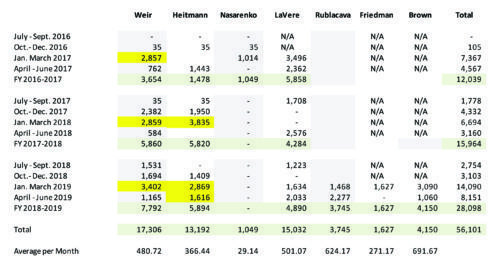
It’s immediately clear that the spending by the active Councilmembers is rising year-over-year. It jumped 32% to $15,964 from $12,039 from Fiscal Year 2016-2017 to Fiscal Year 2017-2018. It increased 76% to $28,098 from $15,964 from Fiscal Year 2017-2018 to Fiscal Year 2018-2019.
Highlighted in yellow is the amount spent each year to attend the National League of Cities (NLC) Conferences. The NLC holds regional conferences and a national conference in Washington, DC.
Where’s The Value From The Conferences?
Ventura taxpayers get little information about the benefits the city derives from these conferences. There are no written reports of what the attendees accomplished. Sometimes, there is a verbal report made to the Economic Development Committee of what happened, as we see in the Agenda for the April 2nd meeting.
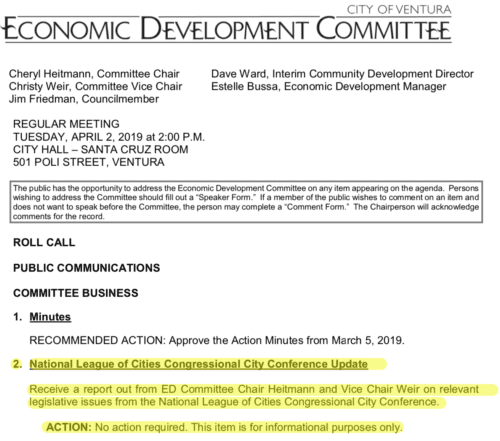
There are no meeting minutes posted for the public of the Economic Development Committee meetings. Nor are the sessions videotaped. There is no permanent record of what happened. There are no archives to refer to in the future. What’s more, the entire City Council doesn’t hear about the findings.
If all the value we receive is a report on the “relevant legislative issues from the NLC,” do we need to send representatives to Washington, D.C.? Couldn’t we get the same information by email or in written form? If we did, there would be a permanent record of the discussions for others to review.
The Value Is In The Connections
The attending City Councilmembers may claim the value of attending these meetings is in the contacts Ventura nurtures with other politicians throughout the country. That’s a specious argument. The relationships are personal between our serving Councilmembers and the people they meet. Those relationships break whenever our Councilmember or his/her contact leaves the office. What’s more, the value in a relationship with a politician in another city has a small direct impact on Ventura.
 The justification may be to learn the “best practices” from other cities attending the conferences. What best practices did we learn on homelessness from representatives from Sacramento, Los Angeles, San Francisco, or Seattle? Homelessness in those cities is worse than it is in Ventura, and it’s not improving. Or did we learn something about water from Sacramento? Except, the California River Tunnel isn’t working out so well. Or did the reps from Washington, D.C., or Sacramento teach us about budgeting? The fact is, our reps need to convey any best practices we learned at those conferences need to city staff. The staff are the ones to put in place new ideas in City Hall. And without written guidelines, implementing the changes is nearly impossible.
The truth is any networking with others at these conferences is nothing more than socializing. Should we pay the expenses for two Councilmembers to hobnob with politicians? No.
Next Conference
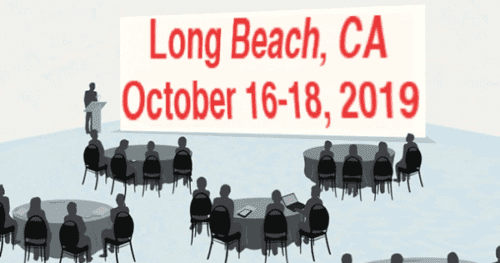
Mayor Matt LaVere, Deputy Mayor Sofia Rubalcava, and Councilmember Brown are attending the National League of Cities Regional Meeting in Long Beach, CA, on October 16-18, 2019. What value will Ventura get from sending three Councilmembers to this meeting?
Editor’s Comments
In the best of times, these conferences may benefit Ventura, but these are not the best of times. The city faces a multimillion-dollar shortfall over the next five years. Frivolous spending of any kind must not happen, regardless of the dollar amount spent. Spending taxpayer money on these seminars and conferences may appear to be harmless at first. Still, scrutinize each trip to decide whether it’s a necessity. And if it is determined to be necessary, the value must outweigh the expense.
Tell City Council, “Spend Better On Conferences!”
Below you’ll find the photos of our current City Council. Click on any Councilmember’s photo and you’ll open your email program ready to write directly to that Councilmember.
 |
 |
|
 |
 |
|
 |
 |
|
 |
For more information like this, subscribe to our newsletter, Res Publica. Click here to enter your name and email address.


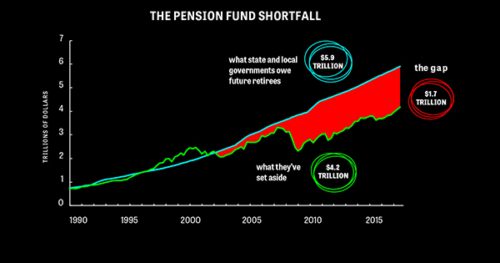
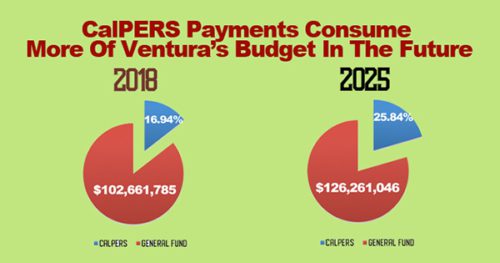
 current ones—have been met with furious opposition. Workers’ representatives and also the plan managers themselves—like CalPERS—oppose changes. That opposition has been mostly successful. Governments at all levels are hamstrung between their duties to provide on-going services to their citizens and their ever-increasing financial obligations to pension funds. In the State of California, once one hires an employee, their retirement cannot be changed.
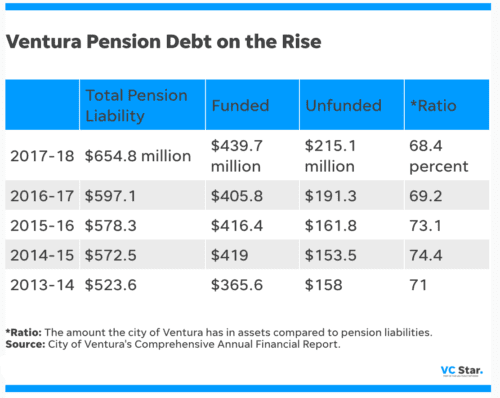
 There are two other choices for our City Council to consider if they have the political will to do anything about this crisis that will cripple the City of Ventura.
 Public sector employees may resist the changes but think about it. Private sector employees don’t get their full social security until 65 or even 67, depending the year they were born. Moreover, Social Security is only going to be one quarter to one-half of your working earnings.


 In an interview with Rachel Woodward, she revealed that she kept meticulous notes. She has a complete phone and paper trail of all dates and times that someone spoke to her, and a list of appointments and promises broken from representatives from City Hall. Rachel felt she needed to keep these records. She got the impression that everyone at City Hall was “very defensive,” and nobody wanted to be “held responsible” for what had occurred before the June 24th meeting.
 Rachel further felt that it was also apparent that few, if anyone, was in the community visiting businesses. And, when someone visited a company, there weren’t clear directions on how to streamline the process.




 The Clean Power Alliance is a 2-year-old electricity provider in Southern California. They claim to bring clean, renewable energy at competitive rates. They compete with Southern California Edison (SCE), which has been around for 111 years and has been continually working on renewable energy for over ten years.

 Councilman Jim Friedman got it right when he voted no. When he expressed that, “The budget is $3.5 million in the red now, and this just makes it worse.” By voting to pay more to the CPA—money the city does not have—city services will suffer. Your streets won’t get paved. The city doesn’t hire a police officer. Your water and wastewater rates increase. The police and fire departments don’t respond in time to save a life. If any of these things happen, you only need to look to four members of our City council for their budget decisions. (Mses. Heitmann, Weir, Brown and Rubalcava)
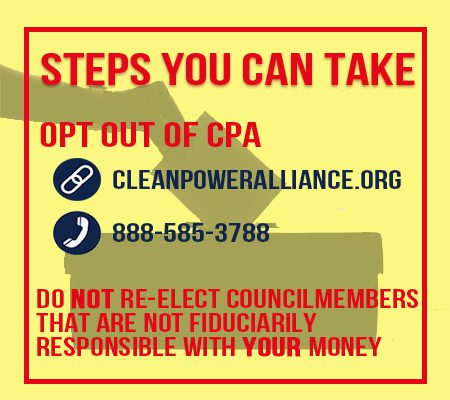
 The City Council chose your electricity provider for you. In so doing, they shifted the burden of “Green Power” to every homeowner in the city. So, if you did not opt-out, you’ll pay higher electricity bills. We should resent the City Council forcing this upon the community. The CPA program should be a decision for each citizen to make. In this case, the government effectively enrolled everyone automatically without any consent from the citizens who will be paying the bill.



 A second problem is how special interest groups lined up to get their share of Measure O. At the May 20th City Council meeting, Councilmembers Lorrie Brown, Jim Friedman and Mayor Matt LaVere tried to move funds from Measure O to the General Fund for Fire Station No. 4.
 Economic disasters are all around us. There is no reason to think that Ventura is immune to them. The City of Oxnard is preparing to lay off hundreds of employees. They also plan to close a fire station and reduce the number of fire personnel available to respond to emergencies. The Oxnard City Manager says, “We are down to bare bones.” What’s happening in Oxnard is a preview of what could happen in Ventura unless the City Council acts quickly.
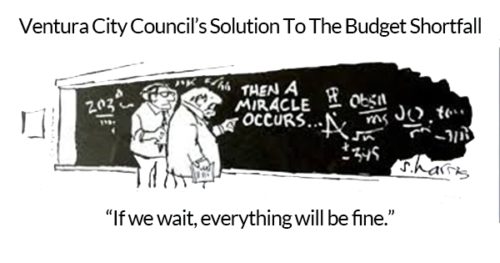 The budgetary crisis is entirely avoidable if the City Council acts now. The solutions are simple, but they are not easy. It requires significant political will and resolve.

 Imagine the stimulus to the community of filling the old Star Free-Press building or the Toys-R-Us location would have.
 Any change to the Fire Department would likely be unpopular with the public. That makes it a subject considered by Councilmembers, to be too controversial to discuss. The fire department union will become protective of their fellow firefighters and will want to preserve the status quo.



 The Council has proposed some significant changes. They include:
 Every Planning Commissioner would be accountable to the Councilmember who appointed him or her.
 The proposed changes don’t please everyone. The immediate resistance came from some existing committee members and commissioners. There are two main objections. Some complained about the process. Others believe there will be less transparency and citizen involvement.



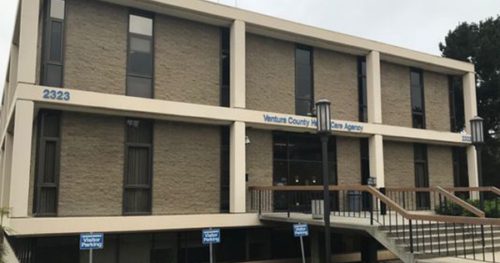 Topping the mayor’s list of priorities was opening a permanent, full-service homeless shelter by December 31, 2019. The date gives this goal specificity. Opening the center doesn’t begin to solve the problem, though. Mayor LaVere and the City Council equate opening a homeless center with improving Ventura’s homeless situation. They are not the same thing.
 What’s more, the City Council conflates opening the center with helping the homeless. The goal shouldn’t be to have beds available. That’s an intermediary step. The goal should be to get the homeless off the street and return them to a healthy way of life.

 Mayor LaVere’s fourth goal is to beautify the community. He wants to end what he termed “blight.”
 The mayor hopes to achieve this goal by building community parks. The Westside Community Park set the model. Mayor LaVere’s first target is Mission Park.
 Mission Park is home to a growing number of Ventura’s homeless population. To prepare the area, the homeless must move elsewhere. The 55-bed homeless shelter isn’t the solution. Also, even if we scatter the homeless, there are safety issues. Someone would have to clean the discarded needles, drug paraphernalia and human waste from the park.
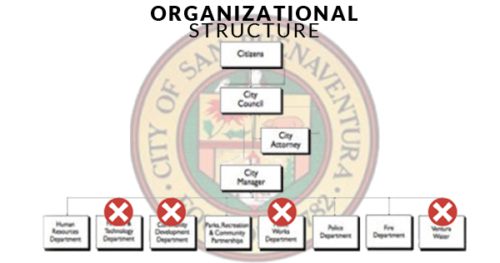 The need for key personnel is a huge problem. To fulfill any of our mayor’s goals requires adequate staff. The final 2019-2020 goal is to stabilize and strengthen our city government. The city has eight unfilled, critical managerial positions and dozens of vacant jobs. The city will achieve none of the other ambitious goals if there aren’t enough workers at City Hall.

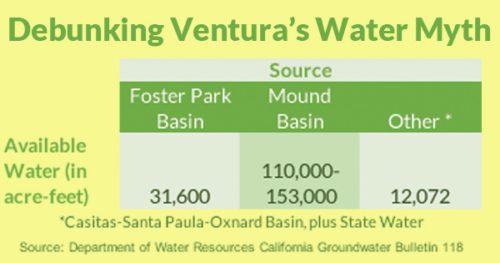

 Costing over $500,000,000 is not the only issue. The more significant issue is that the City Council assumed DPR water was safe to drink.
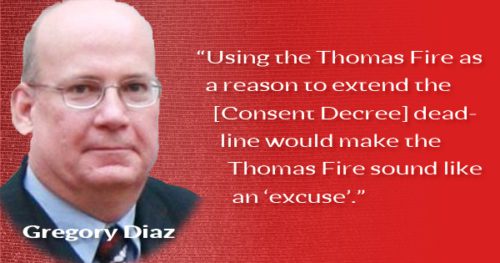
 However, the Consent Decree says the court can extend the time limit in the event of construction constraints, financing problems, or an emergency. It requires Ventura to petition the court requesting an extension, or an agreement with the plaintiff and their lawyers. That has not happened.
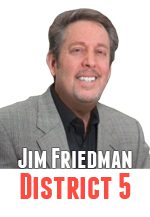 On February 4, 2019, Council Member Jim Friedman asked our City Attorney, Gregory Diaz about extending the deadline.



 Ventura Water forces the City Council to get their information from the General Manager. Thus bypassing the entire reason the city established the Water Commission.
 You may not have heard about the incident. It’s not because Ventura Water didn’t announce it. They did. Ventura Water fulfilled the letter of the law, but it may have missed the intent behind it. Meeting the legal requirement seems to be the minimum standard. Yet setting the bar at the lowest level may place everyone’s health at risk in the future.
 In July, Ventura Water withheld information from the Water Commission. A panel of experts examined



 The City Council waffles on second-story height restrictions for
 The City Council instructs Ventura Water to focus on connecting to State Water