Proposition 218 Is The Fastest Way To Raise Money, But Is It Right?
 “I have never understood why it is ‘greed’ to want to keep the money you’ve earned, but not greed to want to take somebody else’s money.”
—Thomas Jefferson

Ventura Water will push the boundaries of the law as it tries to use Proposition 218 to raise money to meet the Wishtoya Foundation Consent Decree.
In the next 12 months, Ventura Water will ask the City Council to increase water rates for 30 wastewater projects and 28 water projects by 2024. These costly projects will benefit some property owners. Other projects will help the community at large.
As of June 30, 2018, Ventura Water accumulated $115,000,000 for projects they planned to build between 2012-2018. Still, they need $449,586,000 more before 2024. How did we commit to spending almost $450 million, and why weren’t you asked to vote on it?
WHAT WILL THIS COST YOU?
These new rate increases will come on top of the increases imposed over the last six years. In 2012, Ventura Water wanted to increase rates to:
- Replacing aging pipelines and facilities
- Building projects to improve water quality
- Constructing new groundwater wells
In 2012 the average homeowner and family of 4, received a bi-monthly bill of $73.27 and sewer charges of $72.45 for a total of $145.72. That same family is paying $105.03 for water in 2018. Add sewer charges of $104.64 and their total bill is $209.67. This is a 43% increase over the 2012 rates.
From 2018-2024, expect a similar rate of growth. Your new water bill may look like this: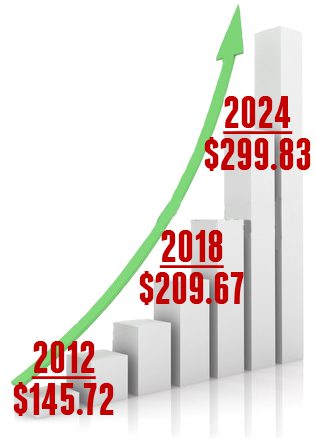
HOW DID WE GET INTO THIS SITUATION?
 In March 2012, the Ventura City Council signed a Consent Decree that requires Ventura Water to stop putting 100% of its treated wastewater into the Santa Clara River estuary by January 2025. The decree stems from a Federal complaint filed by Wishtoya Foundation. Former City Manager, Rick Cole and Ventura Water General Manager, Shana Epstein, signed the consent decree on behalf of the city. The city no longer employs either of them.
Keep in mind that voters had no voice in the City Council consenting to the decree in 2012. Now, Ventura Water wants to deny voters the chance to say how we spend the money to meet the order, too. It plans to use Proposition 218 to get those funds.
HOW AND WHY CAN VENTURA INCREASE MY RATES?
So h ow can Ventura Water impose such large fees against its citizens without the traditional right to vote on such matters? The answer lies in how Ventura implements Proposition 218. Approved by the voters in 1996, Proposition 218 allows Ventura to raise money in one of three ways:
- General taxes. Those taxes used for general governmental purposes. Prop 218 requires the traditional voting procedure, notice, a ballot and an election measure. 51% of the voters must approve it. Ventura’s Measure O sales tax was one such example.
- Special Taxes. Any tax imposed for specific purposes and placed in a general fund. A Special Tax requires a 2/3 (66.67%) majority vote. The City sought this type of tax in 2009. It was Measure A on the ballot. It was a 1/2 cent sales tax for public safety and other specific projects. Monies would have been placed in the city’s General Fund. It failed.
- Special Assessments, Fees and Charges. Fees or charges means an assessment imposed as an incident of owning property which receives a unique benefit. The city can only impose such fees by affirmative voter approval. The exception being that prior voter approval is not required for “any assessment imposed exclusively to finance capital costs or maintenance and operation expenses for sidewalks, streets, sewers, water…”
VENTURA WATER TURNS A NON-VOTE INTO A YES VOTE
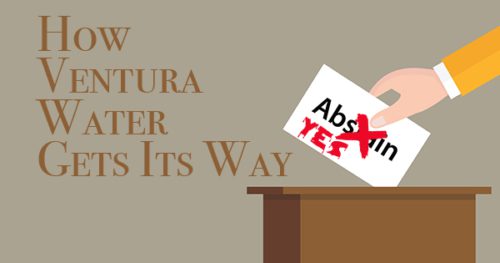
Ventura wants to use option C, Special Assessments, Fees and Charges to impose higher water rates.
Here’s how they’ll do it. Instead of putting it on the ballot, Ventura Water sends a water bill. Somewhere in the body of that bill, it tells you why the rate increase is necessary. You may dispute the rate increase by voting “NO” within 45 days, but the process is cumbersome. To disagree, you must download a protest form, complete and mail it or take it to City Hall by a specific date. Fail to jump over those hurdles and the City doesn’t care what you think or want. If 51% of the ratepayers have not voted ‘NO,’ that is the end of the matter. There are 32,000 ratepayers. Sixteen thousand one must vote NO to defeat an increase.
Proposition 218, now Article XIII C and D of the California Constitution, made the following findings:
“The people of the State of California hereby find and declare that Proposition 13 was intended to provide effective tax relief and to require voter approval of tax increases. However, local governments have subjected taxpayers to excessive tax, assessment, fee and charge increases that not only frustrate the purposes of voter approval for tax increases but also threaten the economic security of all Californians…This measure protects taxpayers by limiting the methods by which local governments exact revenue from taxpayers without their consent.”
When the City sought the last rate increase they took the position that they had the right to raise the rates without prior voter approval. They believed the procedures they followed were consistent with Prop 218 language, as interpreted by the California Supreme Court. They maintain that they “may raise other fees or impose new fees without prior voter approval” for anything they chose to label a water or wastewater project.
But it doesn’t end with this interpretation alone. A California Supreme Court challenge goes further.
TESTED IN THE COURTS
The California Supreme Court in Bighorn-Desert View Water Agency v. Verjil (2006)39 Cal.4th 205, at page 205, addressed the question of whether voters had the right to put an initiative on the ballot to reduce water rates. The court ruled in favor of the water agency and interpreted Prop 218’s language to mean a city “may raise other fees or impose new fees without prior voter approval.” The Court’s decision was specific. It didn’t involve the question of whether imposing fees to deal with a Consent Decree are valid.
Notwithstanding the protective measures of Prop 218, the City of Ventura conveniently interprets Prop 218 to still impose fees and charges beyond the simple costs of service to the homeowner. However, the court never went that far.
The City of Ventura’s interpretation of Proposition 218 is overreaching when it comes to any matter about water, wastewater and related environmental projects.
That decision by the Supreme Court only involved the issue of water delivery through a pipeline and whether voters could use an initiative process to require prior voter approval for the costs of that delivery. It did not involve a question of whether fees imposed to deal with a $500 million water and wastewater projects together with environmental costs, expert studies, attorneys fees and a plethora of expenses arising out of a ConsentDecree decided by a City Council in 2012, and in which the voters had no voice.

What if the costs are not exclusively operational costs? What if the expenditures benefit the entire community, not just ratepayers? Does Proposition 218 apply in those circumstances? Bighorn-Desert View Water Agency v. Verjil does not answer these questions.
No Precedent For What They Plan To Do
In determining whether to seek prior voter approval, we hope that the new City Council will keep in mind the following the language from the Supreme Court in Bighorn case:
“…the agency’s governing board may … raise fees or impose other fees and new fees without prior voter approval. Although this power-sharing arrangement has the potential for conflict, we must presume that both sides will act reasonably and in good faith, and that the political process will eventually lead to compromises that are mutually acceptable and both financially and legally sound.” (Emphasis added).
THE CITY MAY FACE A SERIOUS LEGAL CHALLENGE
If the City is considering rate increase of this magnitude without prior voter approval they should be mindful of the language in Prop 218. It provides that “in any legal action contesting the validity of an assessment, the burden is on the agency (Ventura Water) to demonstrate that the …properties in question receive a special benefit over the benefits conferred on the public at large…”
Complying with the Consent Decree by not putting wastewater into the Santa Clara River benefits all citizens, not just ratepayers.
Editor’s Comments
Ventura Water is proposing a mix of costly projects. Some will benefit property owners, and some will help the community at large. Building a pipeline and related infrastructure to import state water at the cost of $50 million benefits all property owners. Ratepayers generally accept this. Spending beyond that to build projects to satisfy a federal judgment on the Santa Clara Estuary to protect the ecology of the estuary is a problem.
Proposition 218 may not cover projects to meet a federal judgment on the Santa Clara Estuary to protect the ecology. We recommend a vote of the citizens in that instance.
Warn The City Council Of Ventura Water’s Potential Error
Below you’ll find the photos of our current City Council. Click on any Councilmember’s photo and you’ll open your email program ready to write directly to that Councilmember.

Let then know that Venturans must vote on a water rate increase to pay for the consent decree. Not participating in government makes us worse because our city government isn’t working for all of us.
 |
 |
|
 |
 |
|
 |
 |
|
 |
For more information like this, subscribe to our newsletter, Res Publica. Click here to enter your name and email address.


 Mr. McIntyre is no stranger to managing municipalities so it goes without saying that he will become intricately familiar with Ventura’s budget and various legal agreements over the next few months. He begins his working relationship with a seven–member city council, two of which will be new and inexperienced. He also will meet a notoriously entrenched bureaucracy.
 Notwithstanding assurances from the Community Director, after the Thomas fire disaster,
  The next priority will be the education and training needed to help the new city council become fully familiar with city budgets, the Comprehensive Annual Financial Report (CAFR), finances, the Casitas Water Agreement and various other legal agreements, protocols and procedures so future decisions will be based upon a good understanding of past city council actions.
 State experts have reported that Direct Potable Reuse (DPR) of wastewater is not safe for human consumption and further studies on the safe use of that water are not planned for another 3 years. Even if approved, the State of California will then have to develop and approve statewide standards. When and if that happens, this would be followed by a complex EIR and State Water Board hearing process to determine specific standards for Ventura.
 “If you don’t know where you are going, any road will get you there.”

 The new City Council can take three steps to address water. First, they must request a modification to
 Housing Ventura’s homeless was a high priority. Some thought affordable housing was the solution. Others mentioned the homeless shelter. Some interviewees distinguished between the mentally ill living on the streets and the vagrants. Each saw it as a countywide problem with Ventura as its nexus. The county jail and the psychiatric hospital are in Ventura, making the city a natural final destination for the homeless to stay. One interviewee described it as a “catch and release” program by the other cities into Ventura.
 The new Council needs to apply critical thinking and be willing to question all city staff reports and recommendations. To do so requires financial literacy. Each Councilmember must study the city budget and Comprehensive Annual Financial Report (CAFR).
 Many complex issues face Ventura. All City Council candidates need to be aware of the problems and have a plan to address them. We can’t rely on the candidates alone to be knowledgeable. It’s each person’s responsibility to be aware of the challenges before us. It’s equally important that each voter be confident that the candidates understand them. Only then do our elected officials represent us









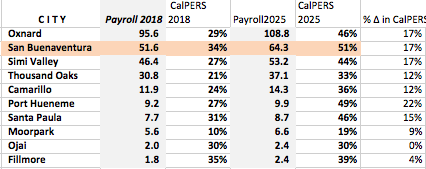 Ventura is already paying 34 cents to CalPERS for every dollar it pays its active employees. In six years, that amount will go up to an unsustainable 51 cents for every dollar of payroll—more than any city in Ventura County. Pensions are already crowding out other essential city services like filling potholes, fixing infrastructure and even hiring more police officers and firefighters.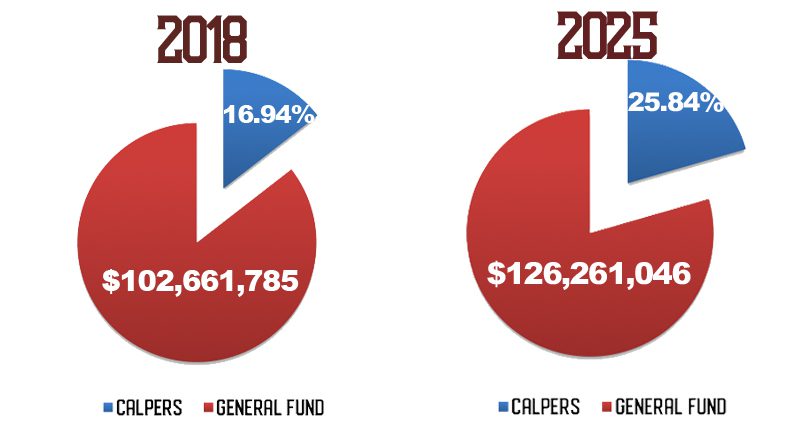





 Ventura needs to get its priorities straight about water—and fast. On July 9th, Ventura Water will ask the City Council to approve direct potable reuse (DPR). Ventura Water views DRP as a primary alternative source for increased drinking water. The project will cost $538 million of taxpayer dollars. The trouble is, it’s an untested, unproven and unregulated solution to our water needs. Why would the City Council gamble with the health of its citizens?
 Two legal agreements jeopardize Ventura’s water supply. The first was a Consent Decree requiring Ventura to cease putting 100% of its treated wastewater into the Santa Clara River estuary. It needs to be diverted somewhere else by January 2025.
 The new Casitas Water contract entitles Ventura an amount of water based on projected needs and adjusted for drought staging conditions. Ventura Water anticipates our water needs at 5,669 acre-feet per year by 2025. By then, they expect we’ll be out of our current drought conditions. Under the1995 contract, Ventura was allowed a minimum of 6,000 acre-feet of water per year. That water could be used in the western part of Ventura (everything west of Mills Road) and the eastern part of the city, if necessary. The new contract changes that and puts East Ventura at a disadvantage. The old agreement allowed Ventura to blend Casitas water with the East End to achieve better quality.
  In August 2016, a report by a state-appointed panel of experts concluded it was “technically” feasible to use DPR, but there are serious health risks. Here are some fundamental problems outlined:
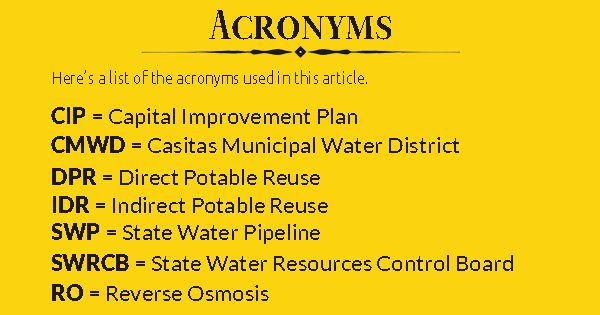
 The cost of DPR wastewater is high. According to the Capital Improvement Plan (CIP), the wastewater and water costs will total approximately $538 million once financing costs are added. Included in those costs are advanced purification facilities to treat the wastewater that will cost $77.7 million. Also included is another $170 million to pump the water north to the desalination/Reverse Osmosis plant. Other infrastructure improvements comprise the remaining costs—including a brine line to carry away contaminants from the new RO plant.




 Then something happened in the city staff presentation that further demonstrated how they lack the knowledge and experience to guide the City Council on rental properties. The Public Works presenter hinted a possible tenant would take the space and finance the tenant improvements in exchange for significantly reduced rent. Almost immediately, Jeff Lambert, the Community Development Director, corrected that information. The potential new tenant had pulled out earlier that week. There were no interested parties, at this time. It was apparent these two departments were not communicating, and the facts were not straight before asking the City Council to spend $2 million.



 City Manager
 Water Department’s New General Manager