Ways Ventura Lost In The Harbor Church Deal

“You’ll Never Reach Your Destination If You Stop And Throw Stones At Every Dog That Barks” —Winston Churchill
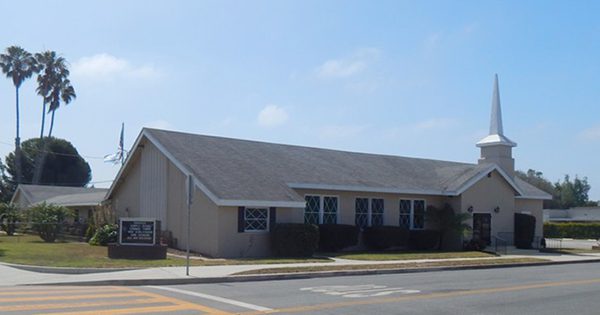
Harbor Church in midtown Ventura
When it comes to real estate, Ventura’s City Council is, at best, inconsistent. At worst, they are reckless with our money. Their latest decision costs taxpayers over $1,000,000.
On June 16th, the Council accepted the city staff’s recommendations for the Harbor Church. Like some other real estate recommendations, it loses money.
How We Got Here
The Harbor Church—located in midtown Ventura—was feeding the homeless as part of their outreach program. Nearby residents were upset with the homeless. They asked the city to get Harbor Church to stop. The city said, “Stop it.” The church cried, “You’re violating our religious freedoms,” and threatened to sue.
The city is weak-kneed and folds at the hint of a lawsuit. Their solution was to buy out the Harbor Church to get them to move. City officials will claim this solution was less expensive than the legal costs of a suit but, at the heart of it, this is still a real estate transaction.
Nothing About This Deal Adds Up
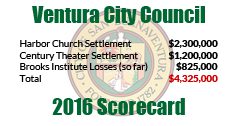
2016 was a year of financial mistakes for the city.
The city paid church officials $2,300,000 to buy the Harbor Church property in 2016. City Hall and Harbor Church agreed the value of both the land and the church building was $1.6 million. The actual sales price included an additional $700,000 to pay the Church to move. By any measure, Ventura overpaid for the property.
City staff proposes to demolish the church, subdivide the property and sell the lots. Total cost to the taxpayers to clear the lot will be $2,670,000.
Purchase Harbor Church Building $1,600,000
Moving Expense $700,000
Demolish Church Building $350,000
Remove Hazardous Material $20,000
Total $2,670,000
The city staff enthusiastically reported the value of the property on which the Harbor Church sits increased by 66% since 2016. We see that factored into their optimistic projections. They believe we can get four lots on the existing site. They estimate each lot will sell for between $250,000 and $375,000.
The arithmetic didn’t add up from the beginning. A staff report lists the property and building appraisal at $1,350,000 in July 2017. A year earlier, the city paid $1,600,000 for the church and the lot—$250,000 more than the appraised value. This transaction lost money from the very start and doesn’t begin to realize the gains from the purported 66% increase in land value.
Something Else Doesn’t Add Up Either
The city staff used an optimistically over-valued selling price for the lots.
We pulled data from a local title company for homes sold in zip code 93003 for the past two years. What we discovered was shocking.
| Average | Median | Avg SF | $/SF | # Sales | |
| 2016 | $ 628,321 | $ 595,000 | 1619 | 388 | 184 |
| 2017 | $ 633,269 | $ 599,000 | 1700 | 372 | 322 |
| 2018 | $ 593,415 | $ 594,000 | 1747 | 340 | 179 |
According to the data, lots on Harbor Church’s corner should sell for between $215,000 and $233,000. We derived those figures using the standard property developer’s rule-of-thumb. The land is worth 1/3 of a home’s selling price. The market values the lots are well below the $250,000 to $375,000 the city staff believes they’re worth.
A More Realistic Calculation Of The Transaction
Using this realistic data from the title company and giving the city the higher anticipated value, the sale of the property would actually look something like this:
Sell Four Lots ($233,000 each) $932,000
Lease Payments From Harbor
Church For 12 months $36,000
Realtor’s Fee (6%) ($55,920)
Total Revenue $912,080
Total Costs (from above) ($2,670,000)
Total Loss on Transaction ($1,757,920)
Is The City Looking Out For Your Money In These Real Estate Transactions?
In April, the City Council sought outside experts for a real estate decision on the property at 505 Poli. The city staff made a recommendation that made the City Council uneasy. The Council instructed city staff to seek advice from a licensed commercial realtor. The Council wants to determine the actual value of the property. As far as we know, city staff has not reported the findings to the City Council in the last 90 days.
The Council was cautious with 505 Poli. They appeared skeptical of the city staff’s recommendations. They were willing to await the findings of an independent appraiser. So, why was the City Council so willing to accept staff’s opinion on the Harbor Church property?
The Council voted 6-0 to proceed based on city staff’s recommendation. Councilmember Jim Monahan was absent at the meeting. The City Council was uneasy with staff’s 505 Poli valuation and recommendations. One would think the Council should be cautious with the Harbor Church property, too.
The City Council’s inconsistent real estate decisions should concern citizens. It causes taxpayers to doubt their financial acumen. The Council trusted the city staff again, with the same disastrous, money-losing results. Decisions that lose over $1,000,000 makes one question whether they are good custodians of our tax money.
Editor’s Comments

We’ve believed the city should get out of the real estate business for a long time. The litany of poor decisions grows—the WAV Building, Brooks Institute lease, 505 Poli and the Harbor Church property.
Ventura owns commercial real estate throughout the city. As these examples demonstrate, the city has not made financially responsible decisions regarding these properties. We recommend the city to seek an independent appraisal of its property, and then to sell it to private enterprise. The city could then take the proceeds and invest them to cover the huge unfunded pension liabilities we face in the coming years.
At the very least, the city should seek advice from licensed realtors and experts whenever making a real estate decision.
Large financial decisions deserve scrutiny. When stewarding taxpayer money, it’s best to proceed with caution and with thought. It’s too easy for city staff to recommend spending taxpayer money on losing projects. We urge the City Council to approach each real estate transaction with skepticism. Treat the money as if it was coming out of their own pockets.
Insist Ventura Gets Out Of Commercial Real Estate
Below you’ll find the photos of our current City Council. Click on any Councilmember’s photo and you’ll open your email program so you can write directly to that Councilmember.
Let them know what you’re thinking. Tell them what they’re doing right and what they could improve upon. Share your opinion. Not participating in government weakens our democracy because our city government isn’t working for all of us.
 Neal Andrews, Mayor |
 Matt LaVere, Deputy Mayor |
|
 Cheryl Heitmann |
 Jim Monahan |
|
 Erik Nasarenko |
 Mike Tracy |
|
 Christy Weir |
For more information like this, subscribe to our newsletter, Res Publica. Click here to enter your name and email address.
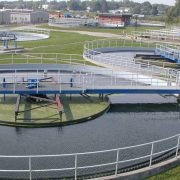

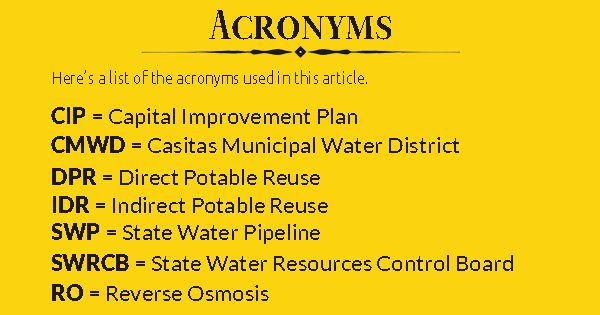
 Ventura needs to get its priorities straight about water—and fast. On July 9th, Ventura Water will ask the City Council to approve direct potable reuse (DPR). Ventura Water views DRP as a primary alternative source for increased drinking water. The project will cost $538 million of taxpayer dollars. The trouble is, it’s an untested, unproven and unregulated solution to our water needs. Why would the City Council gamble with the health of its citizens?
 Two legal agreements jeopardize Ventura’s water supply. The first was a Consent Decree requiring Ventura to cease putting 100% of its treated wastewater into the Santa Clara River estuary. It needs to be diverted somewhere else by January 2025.
 The new Casitas Water contract entitles Ventura an amount of water based on projected needs and adjusted for drought staging conditions. Ventura Water anticipates our water needs at 5,669 acre-feet per year by 2025. By then, they expect we’ll be out of our current drought conditions. Under the1995 contract, Ventura was allowed a minimum of 6,000 acre-feet of water per year. That water could be used in the western part of Ventura (everything west of Mills Road) and the eastern part of the city, if necessary. The new contract changes that and puts East Ventura at a disadvantage. The old agreement allowed Ventura to blend Casitas water with the East End to achieve better quality.
  In August 2016, a report by a state-appointed panel of experts concluded it was “technically” feasible to use DPR, but there are serious health risks. Here are some fundamental problems outlined:
 The cost of DPR wastewater is high. According to the Capital Improvement Plan (CIP), the wastewater and water costs will total approximately $538 million once financing costs are added. Included in those costs are advanced purification facilities to treat the wastewater that will cost $77.7 million. Also included is another $170 million to pump the water north to the desalination/Reverse Osmosis plant. Other infrastructure improvements comprise the remaining costs—including a brine line to carry away contaminants from the new RO plant.
 The City Council must make a policy decision now and direct Ventura Water to concentrate on the importation of State Water immediately. The current effort to plan, finance and build a VenturaWaterPure treatment plant and RO plant to process recycled water for DPR by 2025 must stop or at the very least be delayed until further study. We only hope that the City Council has the leadership and strength to change course and not feel bound by this misguided concept of past water leaders.




 Then something happened in the city staff presentation that further demonstrated how they lack the knowledge and experience to guide the City Council on rental properties. The Public Works presenter hinted a possible tenant would take the space and finance the tenant improvements in exchange for significantly reduced rent. Almost immediately, Jeff Lambert, the Community Development Director, corrected that information. The potential new tenant had pulled out earlier that week. There were no interested parties, at this time. It was apparent these two departments were not communicating, and the facts were not straight before asking the City Council to spend $2 million.



 City Manager
 Water Department’s New General Manager